Growth Strategy
From Market Interest to Market Presence
How alcohol brands move from demand, buyer interest, or strategic intent to products that are live, shoppable, and ready to sell in-market.
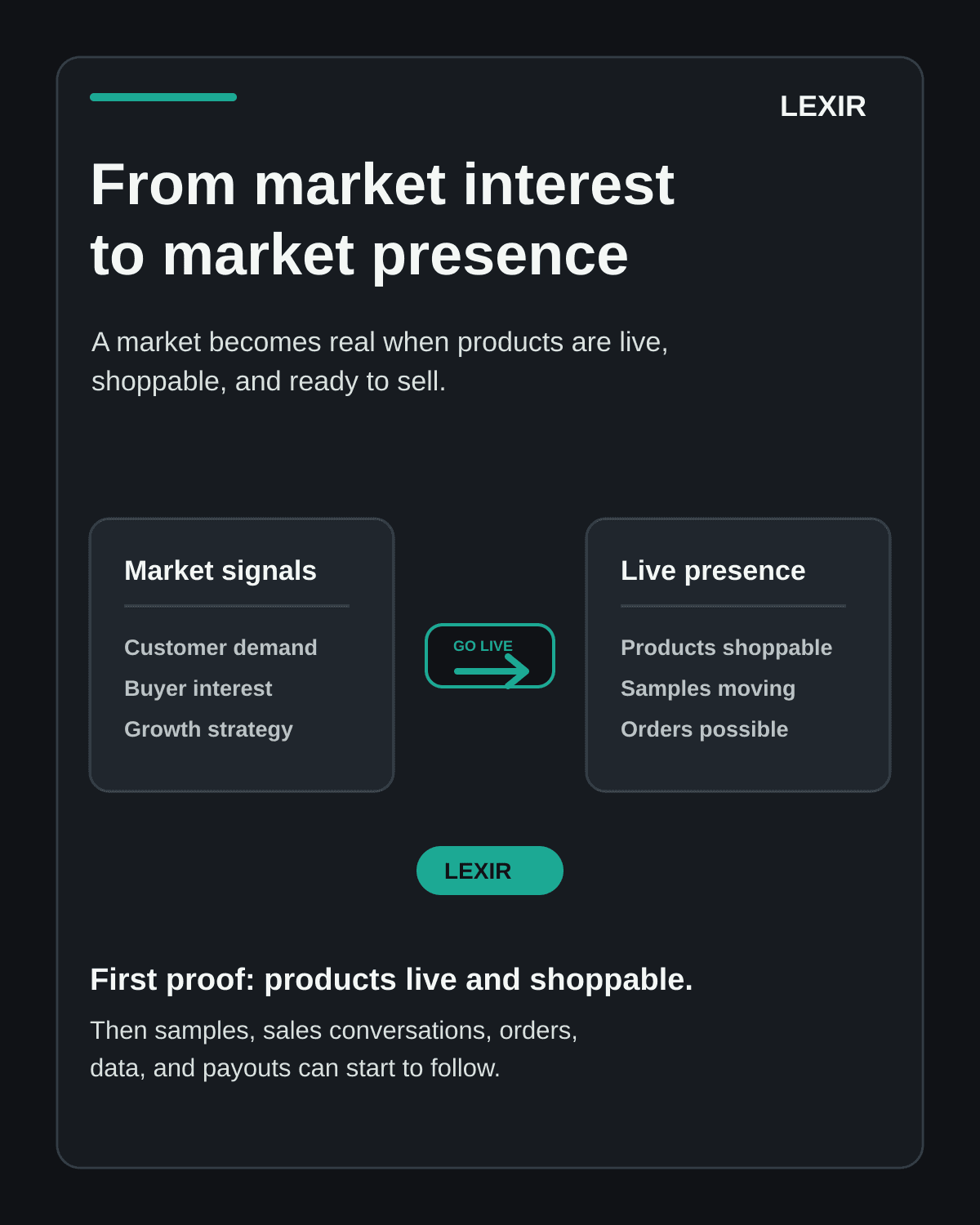
Brands often know where they want to grow before they know how to start.
Sometimes there is already demand in a market. Customers ask. Trade buyers show interest. A retailer wants to explore the product. A sales partner sees potential. Sometimes the reason is more strategic: the brand knows a country should be part of its next stage, or it wants a direct-to-consumer route in Europe, or it needs one market to support a wider regional plan.
Either way, the problem is not always lack of ambition or lack of market interest.
The problem is that being interested in a market is not the same as being live in it.
A brand can have a clear reason to sell in a country and still be stuck outside the practical market. Products are not locally available. Samples are hard to move. Trade conversations stay theoretical. Direct-to-consumer demand cannot be fulfilled properly. Pricing and channel choices depend on structures the brand does not control yet.
That gap is where a lot of market-entry energy disappears.
Traditional routes can work, but they often take time. A brand may spend months looking for a distributor or importer, negotiating terms, trying to make buying prices work, or waiting for a partner to become active. Even when a partner is found, the brand may still have limited flexibility over channels, pricing, discounts, data, samples, and direct sales.
For a smaller brand, that can mean the market never really starts.
For a larger brand, it can mean the brand is technically present but unable to execute the commercial strategy it wants. The products may be in the country, but direct-to-consumer sales, EU-wide campaigns, customer-level pricing, or new channel tests are difficult because the current setup was not built for that kind of flexibility.
The first meaningful milestone is simpler and more concrete:
Products are live and shoppable in the market, in the way the brand needs.
That may mean single-market coverage across trade and consumer channels. It may mean a Pan-EU D2C setup. It may mean starting with selected products and limited stock, then expanding based on what happens. The exact setup depends on the brand's aim. The important shift is that the market stops being an intention and becomes something the brand can act inside.
Once products are live, the next steps become real.
Samples can be sent. Sales partners can be activated. Hospitality, retail, wholesale, distributors, and private consumers can be served through the right channels. Prices can be set by client type. Discounts can be tested. Orders can happen. Data starts to show who bought, what they bought, and when.
That is a different kind of market conversation.
Before products are live, the brand is mostly discussing possibility. After products are live, the brand can work with evidence: which customers respond, which channels create movement, which products fit, where margin holds, and what the next move should be.
This is why Lexir should not be understood only as an import or distribution solution. Import, stock movement, local availability, fulfillment, compliance, and operational support matter because they create the condition the brand actually wants: the ability to sell direct in a new market with more control and flexibility.
The outcome is not paperwork. The outcome is that the brand can start selling.
And for many brands, the first live market can also become a base. Once products are imported into Europe and available locally, the brand may be able to support other European markets from that foothold, send samples, work with partners, fulfill direct orders, and test where the next demand is strongest.
Market entry should not stay abstract for too long.
If a brand has demand, interest, or a strategic reason to enter a market, the most important question is not only who can introduce the brand to someone. It is how quickly the brand can become live, sellable, and able to learn from real market activity.
That is the move from market interest to market presence.
And it is the move Lexir is built to make easier.