Growth Strategy
One Market Is Not One Customer Type
For drinks brands, one country can contain different customer types and different sales routes. The setup should follow the strategy, not force every opportunity through one path.
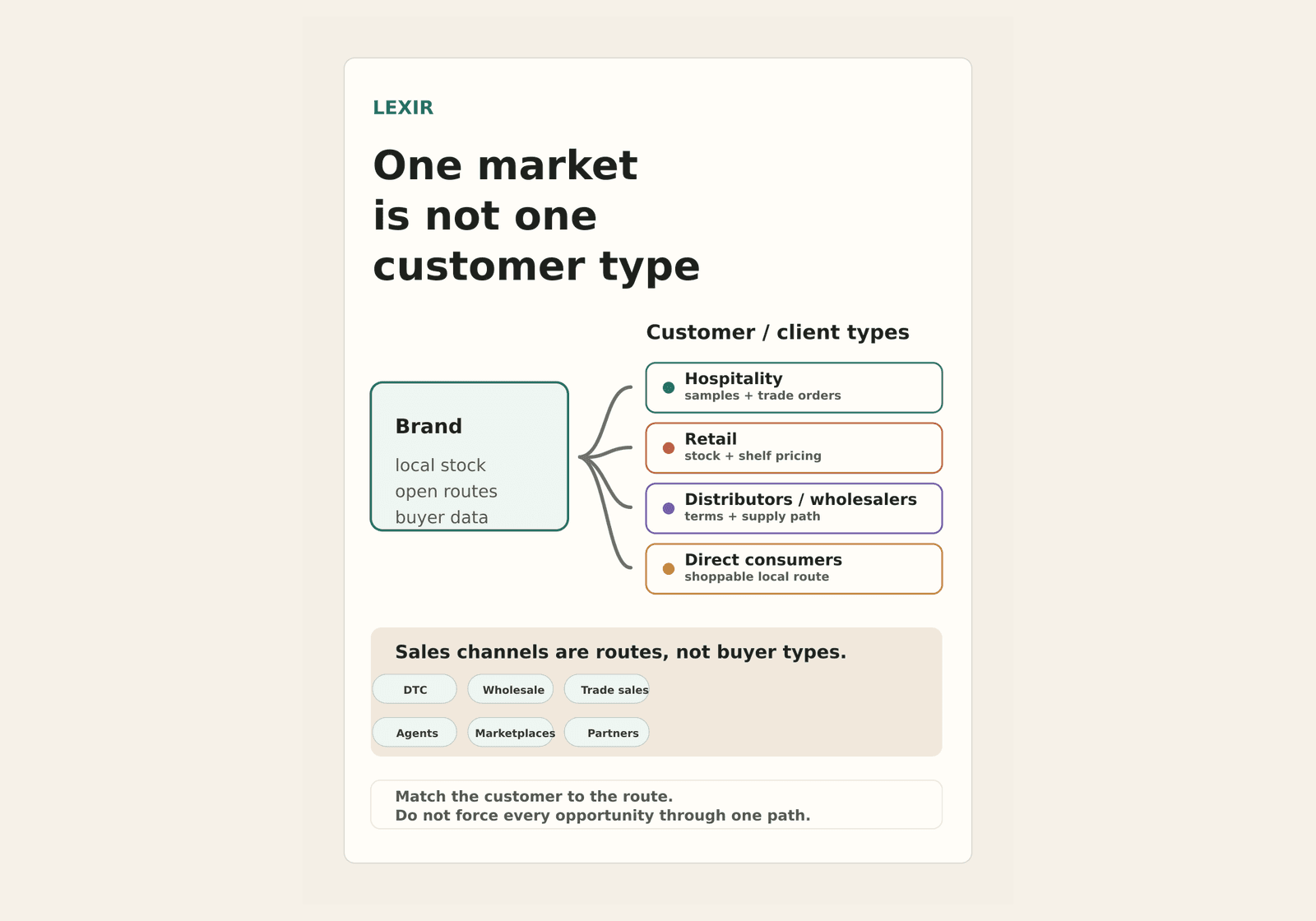
For drinks brands, entering a market is rarely about reaching one single type of customer.
A country can contain several commercial audiences at the same time. Hospitality buyers, retailers, distributors, wholesalers, and direct consumers can all matter, but they do not buy in the same way. They do not need the same support. They do not move through the same sales channel.
That distinction matters.
Customer types and sales channels are related, but they are not the same thing.
Hospitality, retail, distributors, wholesalers, and direct consumers describe who the brand may need to sell to. DTC, wholesale, trade sales, marketplaces, agents, and partner-led selling describe how those routes might be served.
The practical market-entry question is not only whether the brand is present in the market.
The better question is whether the brand can serve the customer types that actually matter, through the right channels for that strategy.
Different Customers Need Different Routes
Hospitality buyers often need samples, trade pricing, product availability, and a simple way to order once interest is live. If the product cannot be sampled or supplied locally, the conversation can lose momentum.
Retail buyers need a different setup. They care about stock, pricing, fulfilment, product information, and whether the brand can support the listing after it goes live.
Distributors and wholesalers need another route again. They may need product availability, commercial terms, trade pricing, margin clarity, and a setup that lets them buy or supply at the right level.
Direct consumers need a shoppable local path. Brand awareness is useful, but interest becomes commercial only when people can actually buy in the market.
These are all part of market entry, but they are not the same job.
Channels Are The Route, Not The Customer
It is easy to mix up clients and sales channels.
A wholesaler can be a customer. Wholesale can also be a channel.
A consumer can be the end customer. DTC is the route used to reach that customer.
Hospitality can buy through a trade order, a wholesale relationship, a marketplace, a sales agent, or a direct brand-led setup.
Retail can be served through a distributor, through direct trade sales, or through another local structure.
Partners, agents, consultants, or local operators can help open doors, but they are not automatically the buyer. They are part of the route.
That is why the market setup needs flexibility. The brand may need to support several customer types, while choosing the right channels for each one.
One Rigid Route Can Miss Useful Demand
Many brands think about a new market as one move: find the local route, get product in, start selling.
In practice, the opportunities can be more fragmented.
There may be a hospitality buyer ready to taste. A retailer interested in a limited listing. A wholesaler who can support one part of the market. A distributor who makes sense for a specific channel. Direct consumer demand that could be served locally if the product were available.
If every opportunity has to pass through one rigid route, the brand has to bend the market around the setup.
That can make useful demand harder to capture.
The brand may have interest, but not the right buying path. It may have a channel partner, but no product availability behind them. It may have direct consumer demand, but no local route to serve it. It may have retail potential, but no flexible way to support pricing, samples, or fulfilment.
The issue is not that the market has no opportunity.
The issue is that the setup is too narrow for the customers and channels the brand needs.
Market Strategy Starts With Customer Priority
A useful market plan should start with a simple question:
Who do we need to sell to first?
For some brands, the first priority is hospitality. Getting bottles into the right bars, restaurants, or trade tastings creates credibility and feedback.
For others, the first priority is retail. The goal is to make product available through selected shops, marketplaces, or specialist sellers.
For some, distributors or wholesalers matter first because the strategy depends on trade coverage, volume, or a specific local supply route.
For others, direct-to-consumer is central. The brand wants a route where customers can buy locally without waiting for a traditional wholesale structure.
The sales channel should follow that answer.
Not every brand needs every route on day one. Trying to serve every customer type at once can create noise. But the market setup should give the brand enough flexibility to choose the paths that matter and build from there.
What Lexir Helps Make Possible
Lexir helps brands create the local commercial rails needed to sell in-market.
That includes the practical foundation: product availability, stock, compliant setup, fulfilment, and the ability to make products live and sellable.
But the value is not only operational.
The value is that the brand has more room to serve the customers and channels that matter.
Hospitality can be supported with samples and trade activity. Retail can be served with available product and clear pricing. Distributors and wholesalers can work from real local availability. Direct consumers can buy where direct selling fits the brand strategy. The brand can see more of what is happening and learn from real activity.
This does not mean the brand should sell everywhere at once.
It means the brand can build the market around the customer types and sales channels that make sense, instead of forcing every opportunity through one route.
The Setup Should Follow The Strategy
Market entry is often discussed as if the main question is whether a brand is in or out of a country.
That is too simple.
A brand can enter a market and still lack the right path to the customer it actually wants to reach.
The stronger question is:
Which customer types matter first, and which sales channels let the brand serve them?
When the answer is clear, the market becomes more practical. Samples can move. Trade conversations can become real. Retail opportunities can be supported. Distributors or wholesalers can be part of the plan where they fit. Direct consumers can buy. The brand can learn from activity instead of waiting for a single route to unlock everything.
One market is not one customer type.
The market setup should not be one path either.